· EEM332
EEM332 Mikroişlemciler: 8086 Adresleme Kipleri
EEM332 – Mikroişlemciler · 01.03.2005 · 18.10.2026
Bu yazı, Başkent Üniversitesi EEM332 Mikroişlemciler ders arşivindeki ilgili notları ve uygulamaları bir araya getiriyor (2005–2015). Doğrudan, dolaylı, taban ve indisli adresleme; segment ve ofsetten fiziksel adresin bulunması. Belgelerin PDF arşiv kopyaları ve varsa kaynak kodları yazının sonunda ZIP olarak indirilebilir.
CPU03_2013
EEM332 Lecture3
Adressing modes in 8086
Addressing Modes:The CPU can access operands (data) in various ways, called addressing modes. In 80x86 there are 7 addressing modes. The number of addressing modes is determined when the microprocessor is designed & cannot be changed The x86 provides seven distinct addressing
- 1 - Register – 5 - Based relative
- 2 - Immediate – 6 - Indexed relative
- 3 - Direct – 7 - Based indexed relative
- 4 - Register indirect
Register addressing mode involves use of registers to hold the data to be manipulated. Memory is not accessed, so it is relatively fast.
Memory is not accessed, so it is relatively fast.
In immediate addressing mode, as the name implies, when the instructionis assembled, the operand comes immediately after the opcode. The source operand is a constant.
Note the bracket around the
addressIn register indirect addressing mode,the address of the memory location where the operand resides is held by a register.
Notice that BX is in brackets. The physical address is calculated by shifting DS left one hex position
and adding BX to itMOV CX, [BX]Example
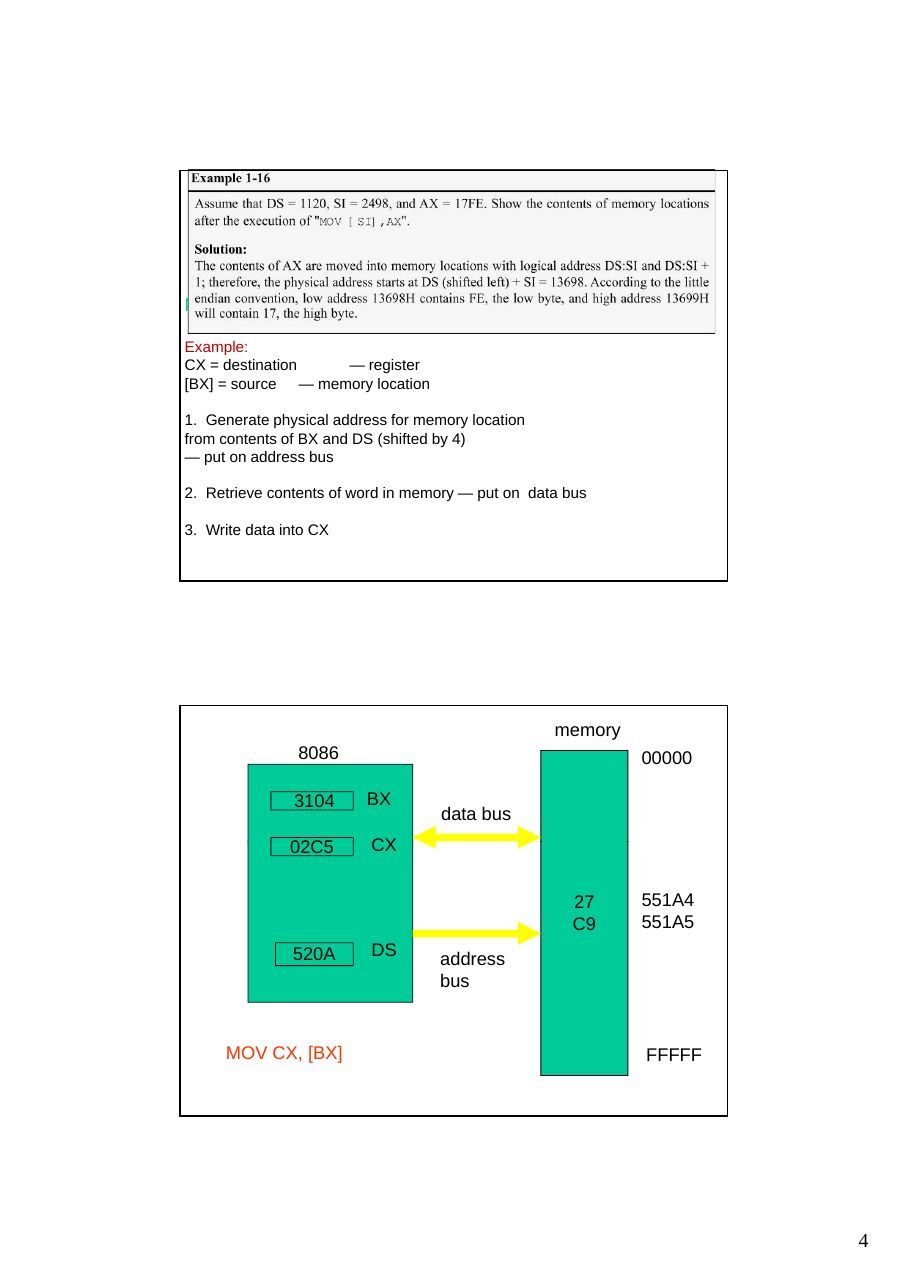
CX = destination — register [BX] = source — memory location
1. Generate physical address for memory location
from contents of BX and DS (shifted by 4) — put on address bus
2. Retrieve contents of word in memory — put on data bus
3. Write data into CX
memory 8086 00000
3104 BX
data bus
02C5 CX
27 551A4
C9 551A5
520A DS address bus
MOV CX, [BX] FFFFFmemory 8086 00000
3104 BX
data bus
02C5 CX
27 551A4
551A4 551A5
C9
520A DS
address
bus
520A0 = DS shifted by 4
+3104 = BX
551A4 = physical address FFFFF
memory 8086 00000
3104 BX
data bus
C927 CX
C927
27 551A4
551A4 551A5
C9
520A DS address bus
FFFFF
4. Register indirect addressing mode: Examples
- The address of the memory location where the operand resides is held by a register.
- SI, DI and BX registers are used as the pointers to hold the offset addresses.
- They must be combined with DS to generate the 20-bit physical address
; moves into AL the contents of the memorylocation pointed to by DS:BX
; move contents of DS:SI into CL
; move the contents of AH into DS:DI
BX contains 0400h Offset 0400h contains ABCDh SI contains 0500h Offset 0500h contains 1000h DI contains 0600h Offset 0600h contains 0045h
INSTRUCTIONS: RESULTS
1. MOV AX,BX AX: 0400h
2. MOV AX,[BX] AX: ABCDh
3. MOV AX,SI AX: 0500h
4. MOV AX,[SI] AX: 1000h
Direct versus indirect addressing mode
address of the data in memory comes immediately after the instruction operand is aconstant The address is the offset address. The offset address is put in a rectangular bracket Ex: MOV AX,[SI] or SUB DX, [BX] indirect addressing
Direct addressing mode
EX
move contents of DS:2400H into DL5. Based relative addressing mode:
BX and BP are known as the base registers. In this mode base registers as well as a displacement value are used to calculate the effective address. The default segments used for the calculation of Physical address (PA) are DS for BX,
and SS for BP.opcode mod r/m displacement
BX
+
BP
effective address
Example: MOV [BX]+1234H, AL DisplacementElement n-1
Data Structure +
Element 1 Base Register Element 0
6. Indexed relative addressing mode:
Indexed relative addressing mode works the same as the based relative
addressing mode. Except the registers DI and SI holds the offset address.Example: MOV AL, [SI]+2000H
01000
01001IP 01002
01003
CS 01004
Index Register Element n-1
DS
SS
ES Array of data
FS +
GS
Element 1 AX Displacement BX Element 0
CX
DX
SP
BP
SI
DI
Adresing modes
7. Based Indexed addressing mode:
The combination of the based and indexed addressing modes. One base register and one index register are used.
opcode mod r/m displacement
DI
+
SI
effective address
Examples: Based and Index Addressing Modes
INSTRUCTION MEANING
SUB CX,[DI+4] Subtract from CX the word located in the data segment at anoffset designated by the contents of DI + 4
MOV AH,[4+DI] Move to AH the byte located in the data segment at an offsetdesignated by the contents of 4 + DI
CMP AX,[BP]+4 Compare the contents of AX with the word on the STACKthat is located at SS + the contents of BP + 4
CMP AX,4+[BP] Compare the contents of AX with the word on the STACKthat is located at SS + 4 + the contents of BP
ADD CX,NUMBERS[SI] Add to CX the word in memory located in the array namedNUMBERS that is offset from the beginning of the array by the value in SI
Accessing the STACK
- When BP is used in register indirect mode, it is understood that
the segment address is in SS- Thus BP can be used to access the STACK without changing the
STACK or the Stack Pointer (SP)
- Example:
MOV     BP,SP             ; Set BP to the value in the stack pointer
MOV     AX,[BP]           ; move the top word on the stack to AX
MOV     BX,[BP+2]         ; move the second word from the top to BX
MOV     CX,[BP+4]         ; move the third word from the top to CX
Moves the 1st (top three) values in the stack to AX, BX, and CXrespectively without changing SP
cpu03_08
Addressing Modes:The CPU can access operands (data) in various ways, called addressing modes. In 80x86 there are 7
addressing modes1. register
2. immediate
3. direct
4. register indirect
5. based relative
6. indexed relative
7. based indexed relative
The default segment register is DS
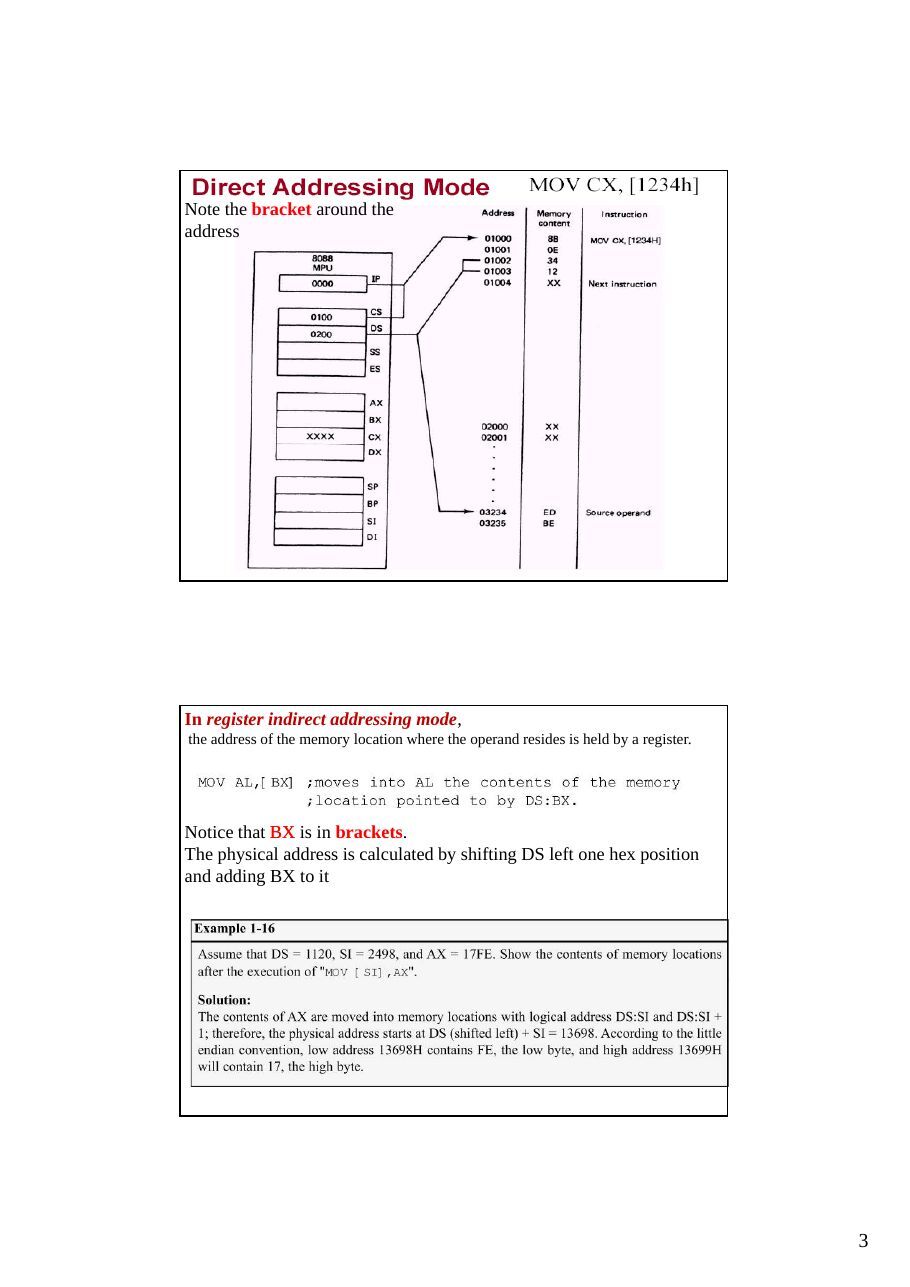
Direct addressing mode
address of the data in memory comes immediately after the instruction operand is aconstant The address is the offset address. The offset address is put in a rectangular bracket Ex: MOV AX,[SI] or SUB DX, [BX]
EX
move contents of DS:2400H into DL- Direct Addressing Mode
- PA = Segment Base : Direct Address
- MOV CX, [1234H]
Instruction (program code)
01000 8B
01001 0E
0000 IP 01002 34
01003 12
0100 CS XX
01004
0200 DS
SS
ES
FS
GS
AX Data
BX
XXXX CX 03234 ED
DX 03235 BE
SP
BP
SI BEED
DI
4. Register indirect addressing mode:
- The address of the memory location where the operand resides is held by a register.
- SI, DI and BX registers are used as the pointers to hold the offset addresses.
- They must be combined with DS to generate the 20-bit physical address
; moves into AL the contents of the memorylocation pointed to by DS:BX
; move contents of DS:SI into CL
; move the contents of AH into DS:DI
BX contains 0400h Offset 0400h contains ABCDh SI contains 0500h Offset 0500h contains 1000h DI contains 0600h Offset 0600h contains 0045h
INSTRUCTIONS: RESULTS
1. MOV AX,BX AX: 0400h
2. MOV AX,[BX] AX: ABCDh
3. MOV AX,SI AX: 0500h
4. MOV AX,[SI] AX: 1000h
MOV CX, [BX]CX = destination — register [BX] = source — memory location
1. Generate physical address for memory location
from contents of BX and DS (shifted by 4) — put on address bus
2. Retrieve contents of word in memory — put on
data bus
3. Write data into CX
memory 8086 00000
3104 BX
data bus
02C5 CX
27 551A4
C9 551A5
520A DS address bus
MOV CX, [BX] FFFFFmemory 8086 00000
3104 BX
data bus
02C5 CX
27 551A4
551A4 551A5
C9
520A DS address bus 520A0 = DS shifted by 4
+3104 = BX
551A4 = physical address FFFFF
memory 8086 00000
3104 BX
data bus
C927 CX C927
27 551A4
551A4 551A5
C9
520A DS address bus
FFFFF
5. Based relative addressing mode:
BX and BP are known as the base registers. In this mode base registers as well as a displacement value are used to calculate the effective address. The default segments used for the calculation of Physical address (PA) are DS for BX,
and SS for BP.opcode mod r/m displacement
BX
+
BP
effective address
Example: MOV [BX]+1234H, AL01000 88 01001 07 Element n-1 0000 IP 01002 34 Displacement 01003 12
0100 CS XX
01004 0200 DS Data Structure
SS +
ES
FS Element 1 GS Base Register Element 0
ED AX
1000 BX
CX 04234
DX 04235
SP
BP
1234 SI
DI
6. Indexed relative addressing mode:
Indexed relative addressing mode works the same as the based relative
addressing mode. Except the registers DI and SI holds the offset address.Example: MOV AL, [SI]+2000H
01000
01001IP 01002
01003
CS
01004 Element n-1 DS Index Register
SS
ES Array of data
FS +
GS
Element 1 AX Displacement BX Element 0
CX
DX
SP
BP
SI
DI
Adresing modes
7. Based Indexed addressing mode:
The combination of the based and indexed addressing modes. One base register and one index register are used.
opcode mod r/m displacement
DI
+
SI
effective address
Examples: Based and Index Addressing Modes
INSTRUCTION MEANING
SUB CX,[DI+4] Subtract from CX the word located in the data segment at anoffset designated by the contents of DI + 4
MOV AH,[4+DI] Move to AH the byte located in the data segment at an offsetdesignated by the contents of 4 + DI
CMP AX,[BP]+4 Compare the contents of AX with the word on the STACKthat is located at SS + the contents of BP + 4
CMP AX,4+[BP] Compare the contents of AX with the word on the STACKthat is located at SS + 4 + the contents of BP
ADD CX,NUMBERS[SI] Add to CX the word in memory located in the array namedNUMBERS that is offset from the beginning of the array by the value in SI
Accessing the STACK
- When BP is used in register indirect mode, it is understood that
the segment address is in SS- Thus BP can be used to access the STACK without changing the
STACK or the Stack Pointer (SP)
- Example:
MOV      BP,SP             ; Set BP to the value in the stack pointer
MOV      AX,[BP]           ; move the top word on the stack to AX
MOV      BX,[BP+2]         ; move the second word from the top to BX
MOV      CX,[BP+4]         ; move the third word from the top to CX
Moves the 1st (top three) values in the stack to AX, BX, and CXrespectively without changing SP
Cp04_06
Addressing Modes:Immediate operand addressing mode Register operand addressing mode Memory operand addressing mode Direct addressing mode Register indirect addressing mode Based addressing mode Indexed addressing mode Based-indexed addressing mode
The default segment register is DS
- Direct Addressing Mode
- PA = Segment Base : Direct Address
- MOV CX, [1234H]
Instruction (program code)
01000 8B
01001 0E
0000 IP 01002 34
01003 12
0100 CS XX
01004
0200 DS
SS
ES
FS
GS
AX Data
BX
XXXX CX 03234 ED
DX 03235 BE
SP
BP
SI BEED
DI
- Effective address is found in either the BX, BP, SI, DI register
- SUB DX, [BX]
Examples
ASSUMPTION: ASSUME all specified offsets are in the DATA Segment
BX contains 0400h Offset 0400h contains ABCDh SI contains 0500h Offset 0500h contains 1000h DI contains 0600h Offset 0600h contains 0045h
INSTRUCTIONS: RESULTS
1. MOV AX,BX AX: 0400h
2. MOV AX,[BX] AX: ABCDh
3. MOV AX,SI AX: 0500h
4. MOV AX,[SI] AX: 1000h
mov al, [bp] ;al gets 8 bits at SS:BPmov ah, [bx] ;ah gets 8 bits at DS:BXmov ax, [di] ;ax gets 16 bits at DS:SImov eax, [si] ;eax gets 32 bits at DS:SIMOV CX, [BX]CX = destination register [BX] = source memory location
1. Generate physical address for memory location
from contents of BX and DS (shifted by 4) put on address bus
2. Retrieve contents of word in memory put on
data bus
3. Write data into CX
memory 8086 00000
3104 BX
data bus
02C5 CX
27 551A4
C9 551A5
520A DS address bus
MOV CX, [BX] FFFFFmemory 8086 00000
3104 BX
data bus
02C5 CX
27 551A4
551A4 551A5
C9
520A DS address bus 520A0 = DS shifted by 4
+3104 = BX
551A4 = physical address FFFFF
memory 8086 00000
3104 BX
data bus
C927 CX C927
27 551A4
551A4 551A5
C9
520A DS address bus
FFFFF
- Based Addressing Mode
- PA = Segment Base : {BX or BP} + {8-bit or 16-bit
displacement}
- Base register : the beginning of a data structure
- See Fig 3.16 (b) in page 74
- Example: MOV [BX]+1234H, AL
01000 88 01001 07
0000 IP 01002 34
01003 12
0100 CS XX
01004
0200 DS
SS
ES Displacement Element n-1
FS
GS
ED AX Data Structure
1000 BX +
CX 04234
DX Element 1 04235 Base Register SP Element 0
BP
1234 SI
DI
Based Addressing
mov al, [bp+2] ;al gets 8 bits at SS:BP+2mov ah, [bx-4] ;ah gets 8 bits at DS:BX-4opcode mod r/m displacement
BX
+
BP
effective address
- Indexed Addressing Mode
- PA = Segment Base : {SI, DI}+{8-bit or 16-bit
displacement}
- Displacement : the starting address of an array;
Index: selects the specific element in the array
- Example: MOV AL, [SI]+2000H
01000 01001
IP 01002
01003
CS
01004
DS
SS
ES
FS
GS
AX Index Register Element n-1
BX
CX
DX Array of data +
SP
BP Element 1 SI Displacement Element 0
DI
Indexed Indirect Addressing
mov ax, [si+1000h] ;ax gets 16 bits at DS:SI+1000hmov eax, [si+300h] ;eax gets 32 bits at DS:SI+300hMov [di+100h], al ;DS:DI+100h gets 8 bits in alopcode mod r/m displacement
DI
+
SI
effective address
- Based-Indexed Addressing Mode
- PA= Seg Base: {BX, BP}+{SI,DI}+{8-bit or
16-bit displacement}
- to access complex data structures
- See fig 3.20 in page 80
- Example: MOV AH, [BX][SI]+1234H
opcode : 8A 44 34 12
Based Indexed Indirect Addressing
mov ax, [bp+di] ;ax gets 16 bits at SS:BP+DImov ax, [di+bp] ;ax gets 16 bits at DS:BP+DImov eax, [bx+si+10h] ;eax gets 32 bits at DS:BX+SI+10hmov cx, [bp+si-7] ;cx gets 16 bits at SS:BP+SI-7opcode mod r/m displacement
DI
+
SI
BX
+
BP
effective address
Addressing Mode Examples
mov al,     bl           ;8-bit register addressing
mov di,     bp           ;16-bit register addressing                           Register
mov eax,    eax          ;32-bit register addressing
mov al,     12           ;8-bit immediate, al<-0ch
mov cx,     faceh        ;16-bit immediate, cx<-64,206                         Immediate
mov ebx,    2h           ;32-bit immediate, ebx<-00000002h
mov al,     LIST         ;al<-8 bits stored at label LIST
mov ch,     DATA         ;ch<-8 bits stored at label DATA                      Direct
mov ds,     DATA2        ;ds<-16 bits stored at label DATA2
mov al,     [bp]         ;al<-8 bits stored at SS:BP
mov ah,     [bx]         ;ah<-8 bits stored at DS:BX
mov ax,     [bp]         ;ax<-16 bits stored at SS:BP
mov eax,    [bx]         ;eax<-32 bits stored at DS:BX
mov al,     [bp+2]       ;al<-8 bits stored at SS:(BP+2)
mov ax,     [bx-4]       ;ax<-16 bits stored at DS:(BX-4)
Based
mov al,     LIST[bp]     ;al<-8 bits stored at SS:(BP+LIST)
mov bx,     LIST[bx]     ;bx<-16 bits stored at DS:(BX+LIST)
mov al,     LIST[bp+2] ;al<-8 bits stored at SS:(BP+2+LIST)
mov ax,     LIST[bx-12h] ;ax<-16 bits stored at DS:(BX-
12+LIST)
More Addressing Mode Examples
mov al,     [si]         ;al<-8 bits stored at DS:SI
mov ah,     [di]         ;ah<-8 bits stored at DS:DI
mov ax,     [si]         ;ax<-16 bits stored at DS:SI
mov eax,    [di]         ;eax<-32 bits stored at DS:DI
mov ax,     es:[di]      ;ax<-16 bits stored at ES:DI         Indexed
mov al,     [si+2]       ;al<-8 bits stored at DS:(SI+2)
mov ax,     [di-4]       ;ax<-16 bits stored at DS:(DI-4)
mov al,     LIST[si]     ;al<-8 bits stored at DS:(SI+LIST)
mov bx,     LIST[di]     ;bx<-16 bits stored at DS:(DI+LIST)
mov al,     LIST[si+2] ;al<-8 bits stored at DS:(SI+2+LIST)
mov ax,     LIST[di-12h] ;ax<-16 bits stored at DS:(DI-18+LIST)
mov al,     [bp+di]      ;al<-8 bits from SS:(BP+DI)
mov ah,     ds:[bp+si] ;ah<-8 bits from DS:(BP+SI)
mov ax,     [bx+si]      ;ax<-16 bits from DS:(BX+SI)
Based
mov eax,    es:[bx+di] ;eax<-32 bits from ES:(BX+DI)            Indexed
mov al,     LIST[bp+di] ;al<-8 bits from SS:(BP+DI+LIST)
mov ax,     LIST[bx+si] ;ax<-16 bits from DS:(BX+SI+LIST)
mov al,     LIST[bp+di-10h]     ;al<-8 bits from SS:(BP+DI-16+LIST)
mov ax,     LIST[bx+si+1AFH]    ;ax<-16 bits from DS:(BX+SI+431+LIST)
Examples: Based and Index Addressing Modes
INSTRUCTION MEANING
SUB CX,[DI+4] Subtract from CX the word located in the data segment at anoffset designated by the contents of DI + 4
MOV AH,[4+DI] Move to AH the byte located in the data segment at an offsetdesignated by the contents of 4 + DI
CMP AX,[BP]+4 Compare the contents of AX with the word on the STACKthat is located at SS + the contents of BP + 4
CMP AX,4+[BP] Compare the contents of AX with the word on the STACKthat is located at SS + 4 + the contents of BP
ADD CX,NUMBERS[SI] Add to CX the word in memory located in the array namedNUMBERS that is offset from the beginning of the array by the value in SI
Accessing the STACK
- When BP is used in register indirect mode, it is understood that
the segment address is in SS- Thus BP can be used to access the STACK without changing the
STACK or the Stack Pointer (SP)
- Example:
MOV     BP,SP            ; Set BP to the value in the stack pointer
MOV     AX,[BP]          ; move the top word on the stack to AX
MOV     BX,[BP+2]        ; move the second word from the top to BX
MOV     CX,[BP+4]        ; move the third word from the top to CX
Moves the 1st (top three) values in the stack to AX, BX, and CXrespectively without changing SP
Cp04
- Direct Addressing Mode
- PA = Segment Base : Direct Address
- MOV CX, [1234H]
Instruction (program code)
01000 8B
01001 0E
0000 IP 01002 34
01003 12
0100 CS XX
01004
0200 DS
SS
ES
FS
GS
AX Data
BX
XXXX CX 03234 ED
DX 03235 BE
SP
BP
SI BEED
DI
- Effective address is found in either the BX, BP, SI, DI register
- SUB DX, [BX]
Examples
ASSUMPTION: ASSUME all specified offsets are in the DATA Segment
BX contains 0400h Offset 0400h contains ABCDh SI contains 0500h Offset 0500h contains 1000h DI contains 0600h Offset 0600h contains 0045h
INSTRUCTIONS: RESULTS
1. MOV AX,BX AX: 0400h
2. MOV AX,[BX] AX: ABCDh
3. MOV AX,SI AX: 0500h
4. MOV AX,[SI] AX: 1000h
Register Indirect
Addressing
mov   al,   [bp]   ;al gets 8 bits at SS:BP
mov ah, [bx] ;ah gets 8 bits at DS:BXmov ax, [di] ;ax gets 16 bits at DS:SImov eax, [si] ;eax gets 32 bits at DS:SI- Register Indirect Addressing Mode
- PA = Segment Base : Indirect Address {BX,BP,SI,DI}
- example : MOV AX, [SI]
01000 8B
01001 04
0000 IP 01002 XX
01003 XX
0100 CS XX
01004
0200 DS
SS
ES
FS
GS
XXXX AX
BX
CX 03234 ED
DX 03235 BE
SP
BP
1234 SI BEED
DI
MOV CX, [BX]CX = destination — register [BX] = source — memory location
1. Generate physical address for memory location
from contents of BX and DS (shifted by 4) — put on address bus
2. Retrieve contents of word in memory — put on
data bus
3. Write data into CX
memory 8086 00000
3104 BX
data bus
02C5 CX
27 551A4
C9 551A5
520A DS address bus
MOV CX, [BX] FFFFFmemory 8086 00000
3104 BX
data bus
02C5 CX
27 551A4
551A4 551A5
C9
520A DS address bus 520A0 = DS shifted by 4
+3104 = BX
551A4 = physical address FFFFF
memory 8086 00000
3104 BX
data bus
C927 CX C927
27 551A4
551A4 551A5
C9
520A DS address bus
FFFFF
- Offsets of data is found by adding some value to the base
register
MOV AX, [BX-2]- Based Addressing Mode
- PA = Segment Base : {BX or BP} + {8-bit or 16-bit displacement}
- Base register : the beginning of a data structure
- See Fig 3.16 (b) in page 74
- Example: MOV [BX]+1234H, AL
01000 88 01001 07
0000 IP 01002 34
01003 12
0100 CS XX
01004
0200 DS
SS
ES
FS
Displacement Element n-1
GS
ED AX
1000 BX Data Structure +
CX 04234
DX 04235 Element 1 SP Base Register Element 0
BP
1234 SI
DI
- Indexed Addressing Mode
- PA = Segment Base : {SI, DI}+{8-bit or 16-bit displacement}
- Displacement : the starting address of an array; Index: selects the
specific element in the array
- Example: MOV AL, [SI]+2000H
01000 01001
IP 01002
01003
CS
01004
DS
SS
ES
FS
GS
AX Index Register Element n-1
BX
CX
DX Array of data +
SP
BP Element 1 SI Displacement Element 0
DI
- Based-Indexed Addressing Mode
- PA= Seg Base: {BX, BP}+{SI,DI}+{8-bit or 16-bit
displacement}
- to access complex data structures
- See fig 3.20 in page 80
- Example: MOV AH, [BX][SI]+1234H
opcode : 8A 44 34 12
Based Indirect Addressing
mov al, [bp+2] ;al gets 8 bits at SS:BP+2mov ah, [bx-4] ;ah gets 8 bits at DS:BX-4opcode mod r/m displacement
BX
+
BP
effective address
Indexed Indirect Addressing
mov ax, [si+1000h] ;ax gets 16 bits at DS:SI+1000hmov eax, [si+300h] ;eax gets 32 bits at DS:SI+300hMov [di+100h], al ;DS:DI+100h gets 8 bits in alopcode mod r/m displacement
DI
+
SI
effective address
Based Indexed Indirect Addressing
mov ax, [bp+di] ;ax gets 16 bits at SS:BP+DImov ax, [di+bp] ;ax gets 16 bits at DS:BP+DImov eax, [bx+si+10h] ;eax gets 32 bits at DS:BX+SI+10hmov cx, [bp+si-7] ;cx gets 16 bits at SS:BP+SI-7opcode mod r/m displacement
DI
+
SI
BX
+
BP
effective address
Addressing Mode Examples
mov al,    bl           ;8-bit register addressing
mov di,    bp           ;16-bit register addressing             Register
mov eax,   eax          ;32-bit register addressing
mov al,    12           ;8-bit immediate, al<-0ch
mov cx,    faceh        ;16-bit immediate, cx<-64,206           Immediate
mov ebx,   2h           ;32-bit immediate, ebx<-00000002h
mov al,    LIST         ;al<-8 bits stored at label LIST
mov ch,    DATA         ;ch<-8 bits stored at label DATA        Direct
mov ds,    DATA2        ;ds<-16 bits stored at label DATA2
mov al,    [bp]         ;al<-8 bits stored at SS:BP
mov ah,    [bx]         ;ah<-8 bits stored at DS:BX
mov ax,    [bp]         ;ax<-16 bits stored at SS:BP
mov eax,   [bx]         ;eax<-32 bits stored at DS:BX
mov al,    [bp+2]       ;al<-8 bits stored at SS:(BP+2)
mov ax,    [bx-4]       ;ax<-16 bits stored at DS:(BX-4)
Based
mov al,    LIST[bp]     ;al<-8 bits stored at SS:(BP+LIST)
mov bx,    LIST[bx]     ;bx<-16 bits stored at DS:(BX+LIST)
mov al,    LIST[bp+2] ;al<-8 bits stored at SS:(BP+2+LIST)
mov ax,    LIST[bx-12h] ;ax<-16 bits stored at DS:(BX-
12+LIST)
More Addressing Mode Examples
mov al,     [si]         ;al<-8 bits stored at DS:SI
mov ah,     [di]         ;ah<-8 bits stored at DS:DI
mov ax,     [si]         ;ax<-16 bits stored at DS:SI
mov eax,    [di]         ;eax<-32 bits stored at DS:DI
mov ax,     es:[di]      ;ax<-16 bits stored at ES:DI         Indexed
mov al,     [si+2]       ;al<-8 bits stored at DS:(SI+2)
mov ax,     [di-4]       ;ax<-16 bits stored at DS:(DI-4)
mov al,     LIST[si]     ;al<-8 bits stored at DS:(SI+LIST)
mov bx,     LIST[di]     ;bx<-16 bits stored at DS:(DI+LIST)
mov al,     LIST[si+2] ;al<-8 bits stored at DS:(SI+2+LIST)
mov ax,     LIST[di-12h] ;ax<-16 bits stored at DS:(DI-18+LIST)
mov al,     [bp+di]      ;al<-8 bits from SS:(BP+DI)
mov ah,     ds:[bp+si] ;ah<-8 bits from DS:(BP+SI)
mov ax,     [bx+si]      ;ax<-16 bits from DS:(BX+SI)          Based
mov eax,    es:[bx+di] ;eax<-32 bits from ES:(BX+DI)           Indexed
mov al,     LIST[bp+di] ;al<-8 bits from SS:(BP+DI+LIST)
mov ax,     LIST[bx+si] ;ax<-16 bits from DS:(BX+SI+LIST)
mov al,     LIST[bp+di-10h]     ;al<-8 bits from SS:(BP+DI-16+LIST)
mov ax,     LIST[bx+si+1AFH]    ;ax<-16 bits from DS:(BX+SI+431+LIST)
Examples: Based and Index Addressing Modes
INSTRUCTION MEANING
SUB CX,[DI+4] Subtract from CX the word located in the data segment at anoffset designated by the contents of DI + 4
MOV AH,[4+DI] Move to AH the byte located in the data segment at an offsetdesignated by the contents of 4 + DI
CMP AX,[BP]+4 Compare the contents of AX with the word on the STACKthat is located at SS + the contents of BP + 4
CMP AX,4+[BP] Compare the contents of AX with the word on the STACKthat is located at SS + 4 + the contents of BP
ADD CX,NUMBERS[SI] Add to CX the word in memory located in the array namedNUMBERS that is offset from the beginning of the array by the value in SI
Accessing the STACK
- When BP is used in register indirect mode, it is understood that
the segment address is in SS- Thus BP can be used to access the STACK without changing the
STACK or the Stack Pointer (SP)
- Example:
MOV     BP,SP            ; Set BP to the value in the stack pointer
MOV     AX,[BP]          ; move the top word on the stack to AX
MOV     BX,[BP+2]        ; move the second word from the top to BX
MOV     CX,[BP+4]        ; move the third word from the top to CX
Moves the 1st (top three) values in the stack to AX, BX, and CXrespectively without changing SP